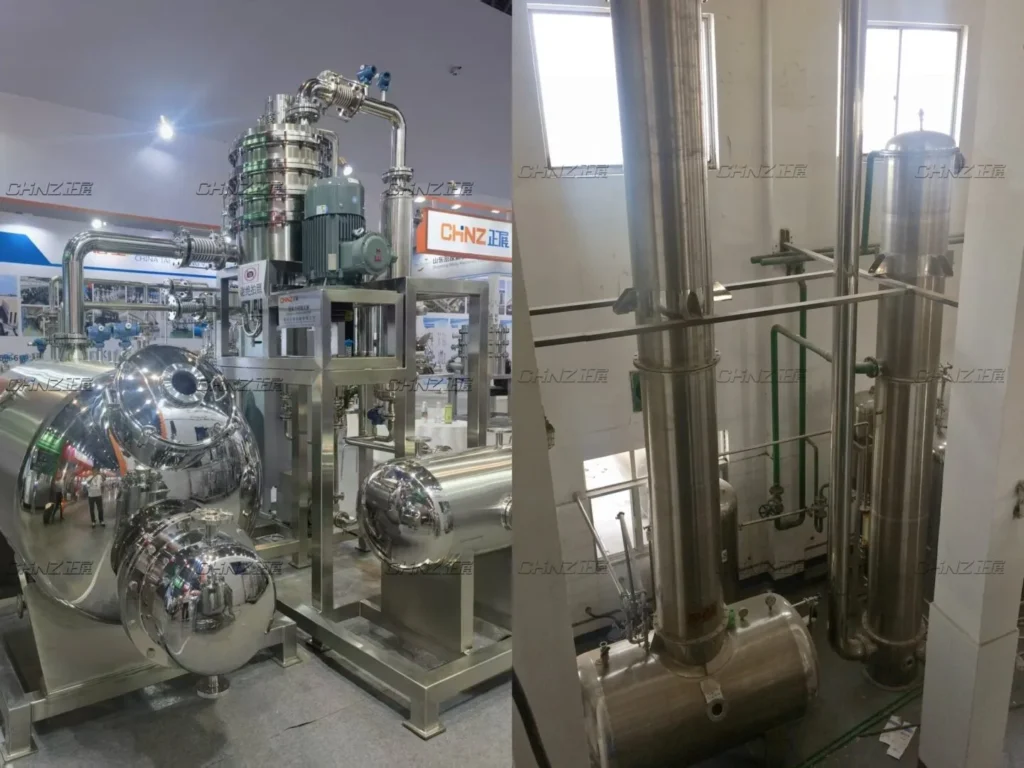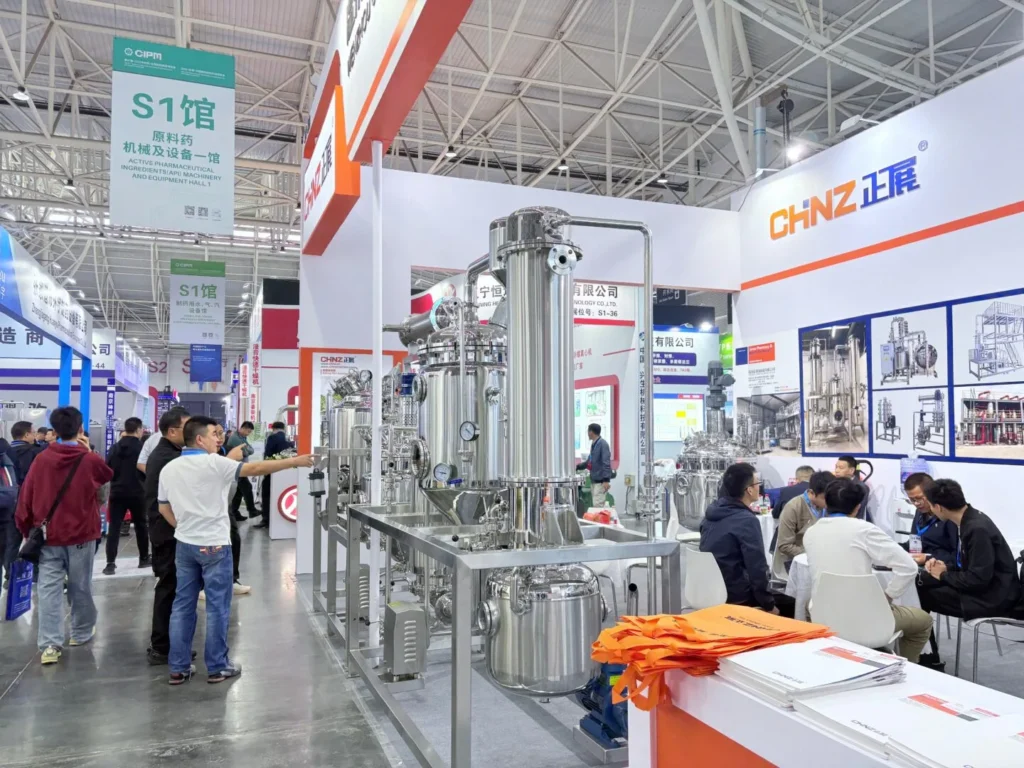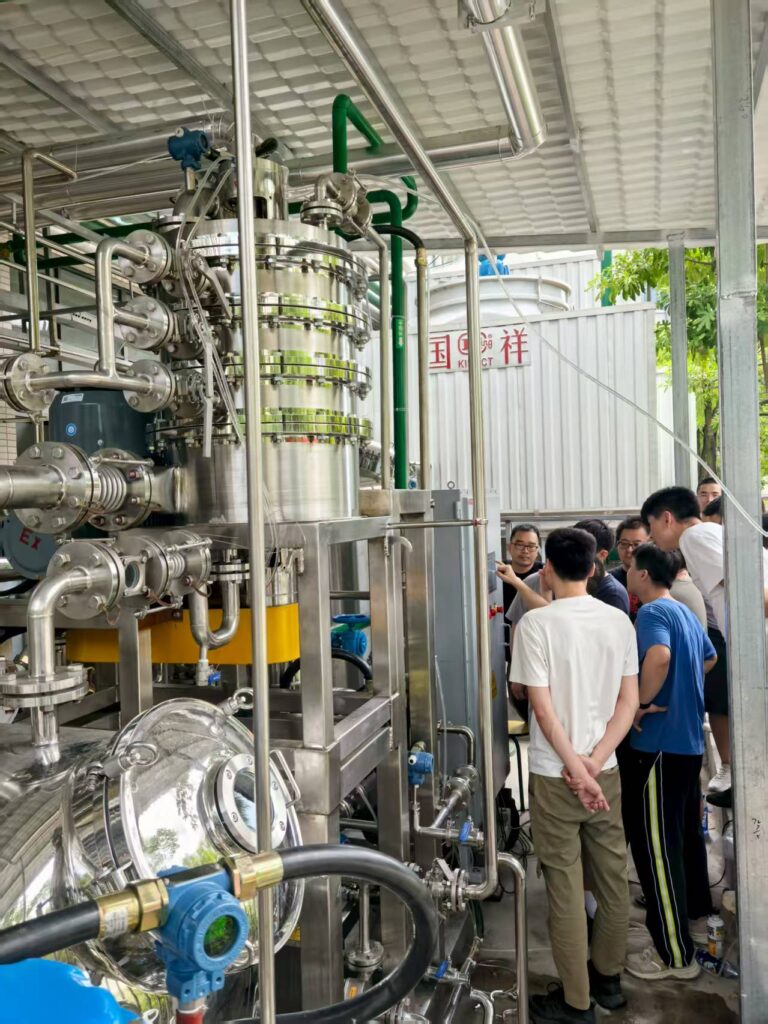
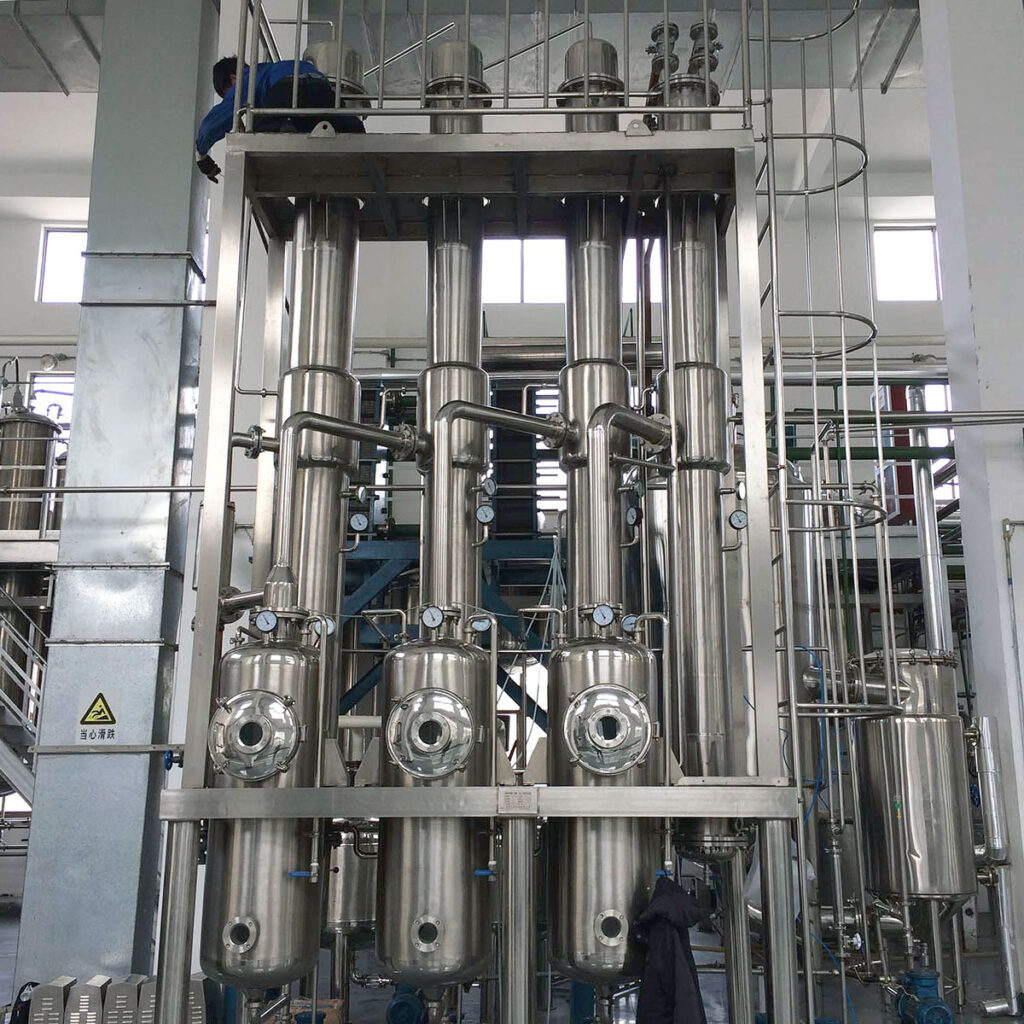
Falling film evaporators represent one of the most energy-efficient and widely used evaporation technologies in process industries. Characterized by their vertical tube or plate design, these evaporators utilize gravity to create thin, rapidly flowing liquid films that achieve exceptionally high heat transfer rates with minimal residence time. Their design makes them particularly suitable for heat-sensitive, viscous, and foaming materials across industries ranging from food and dairy to chemicals and wastewater treatment.
Falling Film Evaporator Product Overview
1. Design & Construction
The system integrates a highly efficient tubular steam heating mechanism with vacuum evaporation. This combination ensures rapid heat transfer and allows evaporation to occur at significantly lower temperatures, preserving product quality and improving thermal efficiency. For condensation, the system utilizes a shell-and-tube condenser paired with a compact coil-type cooling system, providing effective vapor condensation and optimal heat recovery.
2. Major Equipment Components
The complete evaporator skid is comprised of the following core units:
- A. Heater: The primary tubular heat exchanger where steam condenses to provide latent heat.
- B. Separator Vessel: Provides ample volume for efficient vapor-liquid separation.
- C. Condenser: A tubular condenser for liquefying the generated vapor.
- D. Coil-type Cooler: A spiral coil heat exchanger for final product or condensate cooling.
- E. Condensate Tank: Collects condensed steam from the heater.
- F. Feed Pump: Transfers raw material into the system.
- G. Circulation/Discharge Pump: Manages internal recirculation and final concentrated product discharge.
- H. Condensate Pump: Removes condensate from the system.
- I. Vacuum Pump: Creates and maintains the required operating vacuum.
- J. Stainless Steel Support Structure: Provides a rigid and stable framework.
- K. Internal Valves & Piping: A complete network of sanitary valves and tubing for process control.
3. Surface Finish & Hygiene
All internal surfaces in contact with the product are finished to a clean-grade polish, ensuring easy cleaning, sterilization, and preventing bacterial adhesion. The design prioritizes zero sanitary dead ends. External surfaces feature a uniform satin (matte) finish for both aesthetic appeal and practical maintenance.
4. Operating Pressure
The system operates under a vacuum to lower the boiling point. The standard operating vacuum is maintained at approximately -0.08 MPa (gauge pressure).
Operating Principle
The fundamental principle involves latent heat transfer through a thin, turbulent liquid film:
- Feed Distribution: Preheated liquid is evenly distributed across the top of vertical heating elements.
- Film Formation: Gravity pulls the liquid downward, forming a thin film.
- Evaporation: As the film descends, heat from the condensing steam causes partial evaporation, with vapor generated at the liquid-vapor interface.
- Separation: At the evaporator bottom, concentrated liquid is separated from vapor in a centrifugal or gravity separator.
- Vapor Utilization: Vapor can be compressed (in MVR systems) or directed to subsequent effects (in multi-effect configurations).
The thin film ensures:
High heat transfer coefficients
Low pressure drop
Minimal thermal degradation due to short contact time
Effective handling of temperature-sensitive products
Industry Applications
Food and Beverage
- Dairy: Milk, whey, and lactose concentration
- Fruit juices: Apple, orange, and tomato juice concentration without flavor degradation
- Sugar industry: Syrup concentration and refining
- Coffee and tea: Extract concentration
Chemical and Pharmaceutical
- Organic acids: Citric, lactic, and acetic acid concentration
- Polymer solutions: Latex and resin concentration
- Pharmaceuticals: Antibiotic broth concentration and solvent recovery
- Desalination: Seawater and brackish water concentration
Environmental and Waste Management
- Wastewater treatment: Industrial effluent volume reduction
Emerging Applications
- Biofuels: Algae and biomass concentrate processing
Conclusion
Falling film evaporators have evolved from simple vertical tube designs to sophisticated, highly efficient systems integral to modern process engineering. Their ability to handle delicate products while achieving remarkable energy efficiency continues to drive adoption across traditional and emerging industries. Future development will likely focus on further intensification through advanced materials, smart control systems, and deeper integration with circular economy principles—ensuring their continued relevance in an increasingly resource-constrained world.
Related product link:https://chinzmachine.com/product-category/evaporator-concentrator/thin-film-concentrator/